Quick answer: renters insurance covers your belongings (fire, theft, vandalism, some water damage), your liability if someone is hurt in your place, your extra living costs if you’re displaced, and small medical payments to guests. It does not cover floods, earthquakes, or your roommate’s property — each roommate needs their own policy.
You pay for renters insurance every month, but do you actually know what it covers? Most renters can name “my stuff” and stop there. That gap is where surprises happen at claim time.
This guide walks through the four coverages, exclusions, payout methods, and claim scenarios. It’s general information, not insurance or legal advice — always read your own policy.
The four coverages in one standard policy
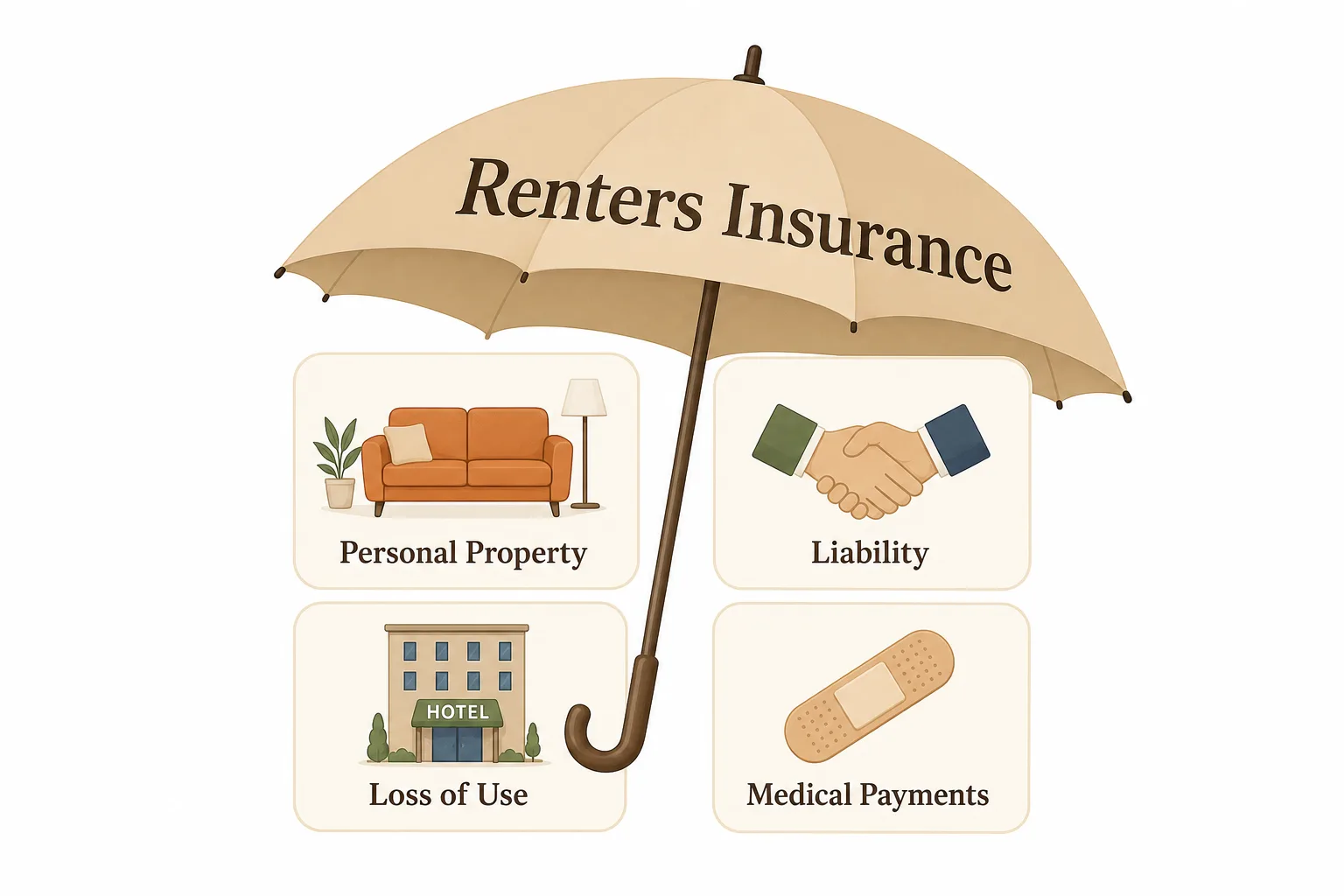
A standard renters policy (HO-4) bundles four distinct coverages. They work together, but they pay for very different things.
| Coverage | What it pays for | Typical limit pattern |
|---|---|---|
| Personal property | Your belongings — furniture, electronics, clothes — if damaged or stolen by a covered event | Commonly $15,000–$50,000, based on your inventory |
| Liability | Legal costs and damages if someone is injured in your unit and you’re found responsible | Commonly $100,000–$300,000 per occurrence |
| Loss of use | Extra living costs (hotel, meals) if a covered event makes your unit unlivable | Often a percentage of your personal property limit, e.g., 20–30% |
| Medical payments to others | Small medical bills for a guest injured in your home, regardless of fault | Commonly $1,000–$5,000 per person |
These four are the skeleton of nearly every renters policy. The details — limits, sublimits, and exclusions — are where the real differences live.
What’s actually covered, item by item
Personal property coverage follows you, not just your apartment. That’s a point most renters miss.
Coverage follows you off-premises
If your laptop is stolen from a coffee shop, your bike is taken from a campus rack, or your suitcase is lost from a hotel room, your renters policy typically covers it — usually at a percentage of your personal property limit, often 10% of the total for off-premises losses. The exact number is in your policy.
Everyday categories that are covered
- Electronics: TV, laptop, phone, gaming console
- Furniture: couch, bed, desk, dresser
- Clothing and shoes
- Kitchen items: cookware, small appliances
- Bike (up to sublimits — see below)
- Sports equipment
The sublimits that surprise people
Even when a category is covered, many policies cap specific high-value items far below your overall limit. These caps are called sublimits.
| Item category | Typical sublimit | Why it matters |
|---|---|---|
| Jewelry and watches | ~$500–$1,500 per item or aggregate | An engagement ring often exceeds this |
| Cash and coins | ~$100–$200 | Cash is rarely worth insuring at home |
| Business property | ~$2,500 | Work-from-home gear needs a rider |
| Bikes | $500–$2,000 | A $3,000 e-bike needs extra coverage |
| Collectibles, art, firearms | Varies widely | Check before assuming coverage |
If an item’s value exceeds its sublimit, you can often add a rider or floater — a scheduled endorsement that raises the limit for that specific item. It costs extra, but it’s the only way to get full protection for a $5,000 ring or a $4,000 camera.
What’s NOT covered (the dealbreakers list)
Knowing what’s excluded is as important as knowing what’s included. These are the gaps that cause the most claim denials.
Floods and earthquakes
Standard renters policies exclude flood and earthquake damage. If a storm surge or a river overflows, your policy won’t pay. Flood coverage requires a separate policy through the National Flood Insurance Program or a private carrier. Earthquake coverage is a separate endorsement. This is standard exclusion wording across the industry.
Your roommate’s property
This is the #1 misconception. A standard policy covers only the named insured and their household members. Your roommate’s laptop, furniture, and clothes are not covered under your policy. Each roommate needs their own policy. If you share a couch, you each need to agree on who insures it — or split a joint item’s value across both policies.
Pests, mold, and wear and tear
Bed bugs, mice, and gradual mold are maintenance issues, not covered events. Your own negligence — leaving a window open during a storm, for example — can also void coverage for that loss.
High-value items beyond sublimits
As covered above, a $10,000 watch is not fully covered under a $1,500 jewelry sublimit. The rider is the fix.
The two payout methods that change everything
How your policy pays for a loss matters more than most renters realize. There are two methods: actual cash value (ACV) and replacement cost (RC).
Actual cash value vs replacement cost
- ACV pays the item’s depreciated value — what it’s worth today, not what it costs to replace.
- Replacement cost pays what it actually costs to buy a new, similar item today.
Worked example: a 3-year-old TV
You bought a 55-inch TV for $800 three years ago. It’s destroyed in a kitchen fire.
- ACV payout: The insurer applies depreciation. A 3-year-old TV might be valued at roughly $150–$200. That’s your check.
- Replacement cost payout: You get enough to buy a comparable new TV today — around $600–$700.
Same loss, same policy event, but the payout difference is roughly 3–4x. That’s the entire ACV-vs-RC debate in one example.
What it costs you
Replacement cost coverage typically costs about 10–25% more in premium than ACV. For most renters, that premium bump is worth it — the payout difference on electronics and furniture alone usually dwarfs the extra monthly cost. If your belongings are older and you’d be fine replacing them with used items, ACV might be acceptable. If you’d want new replacements, choose RC.
Real claim scenarios walkthrough
These are hypothetical worked examples to show how the coverages interact. They are not real claims.
Scenario A: Kitchen fire displaces you for two months
A grease fire damages your kitchen and makes the unit unlivable. Your personal property coverage pays to replace damaged items. Your loss of use coverage pays for a hotel and the extra cost of eating out while you’re displaced — typically up to a percentage of your property limit, often 20–30%. If your property limit is $30,000, that’s up to $6,000–$9,000 for temporary housing and meals.
Scenario B: Laptop stolen from your car
Your laptop is stolen from your locked car in a parking lot. This is an off-premises loss. Your policy covers it, but often at a reduced percentage — commonly 10% of your personal property limit. If your limit is $20,000, that’s $2,000 of off-premises coverage. Your laptop is $1,500, so it’s covered — minus your deductible. If your deductible is $500, you receive $1,000.
Scenario C: Guest trips on your rug
A friend trips on a loose rug in your living room and sprains their wrist. Your liability coverage can pay their medical bills and legal costs if you’re found responsible. Your medical payments coverage can pay smaller bills regardless of fault — commonly up to $1,000–$5,000 per person. This is why the liability limit matters: a serious injury can exceed $100,000–$300,000 quickly.
Scenario D: Upstairs neighbor’s tub overflows
Your upstairs neighbor’s bathtub overflows and damages your ceiling and furniture. This is their liability, not yours. Their policy should pay for your damage. Your policy does not cover damage caused by someone else’s negligence — that’s their problem to fix. If they’re uninsured, you may need to pursue them directly or check whether your policy has any water-damage-from-above coverage (many don’t).
Deductibles and how claims actually work
Your deductible is what you pay before insurance kicks in. It’s the single biggest lever on your premium.
Deductible choice math
A $500 deductible costs more in premium than a $1,000 deductible, but it means you pay less out of pocket at claim time. The right choice depends on your emergency fund. If you can’t comfortably cover $1,000, a lower deductible is the safer pick even if it costs a few dollars more per month.
Does filing raise your premium?
Filing a claim can raise your premium at renewal, and multiple claims can make you harder to insure. This is why the rule of thumb is: don’t file for small losses.
When NOT to file
If a loss is close to your deductible — say, a $600 phone with a $500 deductible — filing gets you $100 and may raise your premium. Paying out of pocket is often the smarter move. A good test: if the claim is under 2–3x your deductible, consider skipping it.
What landlords require vs what you need
Your lease may require a minimum liability limit — commonly $100,000–$300,000 — and proof of coverage before move-in. That requirement is the floor, not the ceiling.
The realistic coverage you need
Your landlord cares about liability. You should care about your belongings. Build a quick home inventory: walk through each room on your phone for 30 minutes, narrating what you see. That video is your claim evidence. Then total the replacement value of your big categories — electronics, furniture, clothes — and set your personal property limit to match.
A common rule of thumb: your personal property limit should be roughly 50% of what it would cost to replace everything you own. If your inventory totals $20,000, a $20,000–$25,000 limit is reasonable.
For the cost side of this decision, see our renters insurance cost guide — it covers pricing, deductibles, and ways to save. And if you’re just starting out, the first apartment checklist and apartment move-in costs will help you budget the rest of your move. Your lease’s insurance clause is worth reading closely — see understanding a lease agreement for what to look for.
FAQ
Is my roommate covered under my renters insurance?
Does renters insurance cover flood damage from a storm?
Does renters insurance cover dog bites?
How much renters insurance coverage do I need?
Image Prompts
Placement: after the four-coverages table (H2-1). Concept: a single umbrella labeled “Renters Insurance” sheltering four labeled panels — Personal Property, Liability, Loss of Use, Medical Payments — each with a small icon (couch, handshake, hotel, bandage). Composition: clean flat illustration, warm neutral palette, umbrella centered and slightly tilted, panels arranged in a 2x2 grid beneath it, generous white space, no text beyond the four labels.
Placement: in the “What’s NOT covered” section (H2-3). Concept: a split visual — left side a green checkmark over a fire icon (covered), right side a red X over a flood wave and an earthquake crack (excluded), with a small roommate silhouette crossed out. Composition: side-by-side comparison, flat vector style, high contrast between green and red zones, minimal text, clear visual separation down the middle, subtle shadow under each icon for depth.
Placement: in the ACV-vs-RC section (H2-4). Concept: the same 55-inch TV shown twice — left side labeled “ACV” with a faded, worn TV and a small stack of cash ($150), right side labeled “Replacement Cost” with a bright new TV and a larger stack of cash ($600). Composition: side-by-side comparison, flat illustration, the two TVs identical in shape but differing in color saturation, cash stacks clearly different heights, labels in small caps, subtle background gradient separating the two halves.