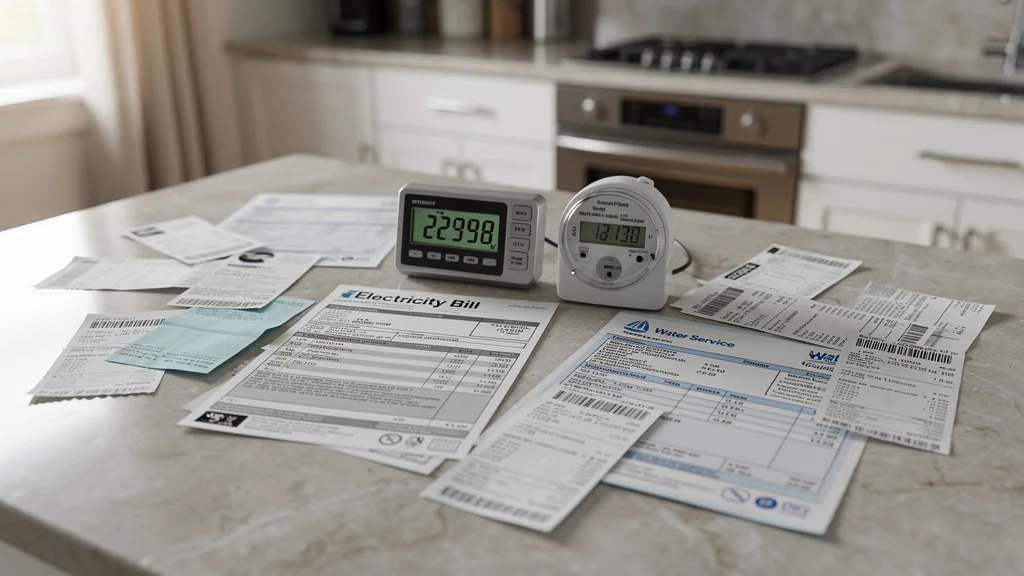
The first ConEd bill landed and nobody agreed on the mechanics yet. That is how every roommate blowup starts: not the money, but the missing system.
Quick answer: Agree in writing before bills arrive. Pick a rent-split method (even, by room, or by income); put each shared utility on one person’s name with a clear repayment rule (each roommate pays within 3 days of the bill posting); track it in a shared sheet or app; and lock it all into your roommate agreement template. The repayment rule kills more disputes than the split itself.
This is general information, not legal advice. Read your own lease — that is where the actual obligations live. Sizing up the full monthly cost first? See how much rent you can afford or the minimum income to rent an apartment breakdown.
The three ways to split rent
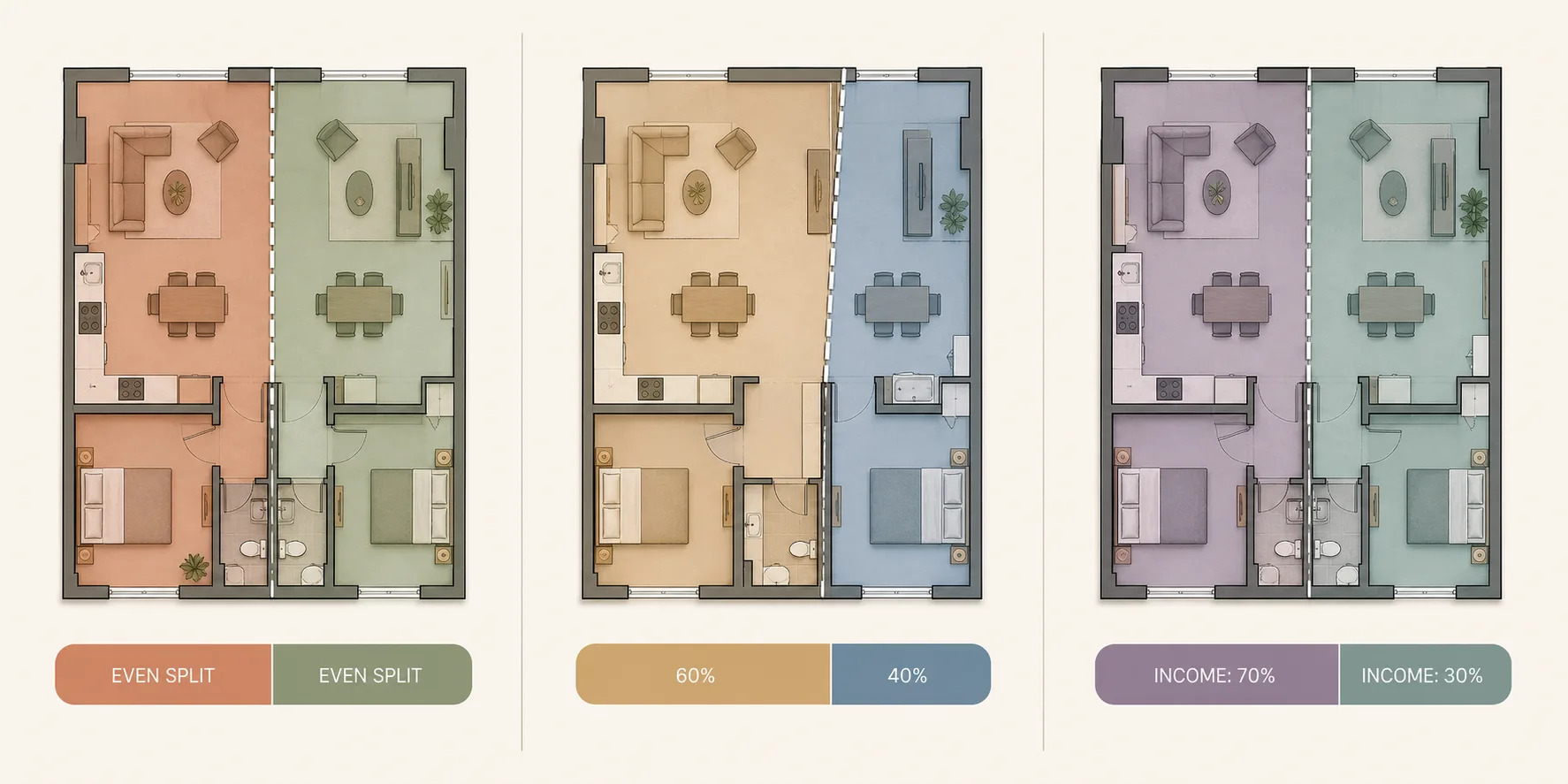
There is no “correct” split. There are three common methods, and the right one depends on your rooms, your incomes, and how honest everyone is about the trade-offs. Pick one, write it down, and hold the line.
| Method | Best for | Fairness trade-off | Main risk if misapplied |
|---|---|---|---|
| Even (by head) | Comparable rooms, similar stays | Simplest to explain and defend | Silently punishes the smaller-room or shared-bath renter |
| By room (pro-rata) | One clearly better room or private vs shared bath | Reflects the space each person actually has | Requires a defensible weighting (60/40 feels arbitrary without a reason) |
| By income | Large income gaps, close relationship | Matches what each person can afford | Hardest to quantify in a dispute; creates ongoing dependency |
Worked examples
Even: A $2,400 rent for two people is $1,200 each. Add $180 internet, split evenly: $90 each. Line item: $1,290 each. The risk: the smaller room pays the same as the master.
By room: Same $2,400. Larger room gets 60% ($1,440), smaller gets 40% ($960). Internet stays even ($90 each). Final: $1,530 and $1,050. The spread is deliberate, which is the point.
By income: Two roommates earn $4,000 and $6,000/month. Against a $2,000 shared rent, the lower earner pays 40% ($800), the higher 60% ($1,200). The ratio mirrors their incomes.
Whichever you pick, the test is the same: the answer to “how much do I owe this month?” should be a number, not a renegotiation.
Utilities: whose name goes on what
Rent is the big number. Utilities are where daily friction lives — and where the legal exposure is easiest to overlook. One mechanic matters more than any other: the account holder is on the hook to the utility, regardless of what you and your roommates agreed.
If you hold the electric account and your roommate ghosts without paying their share, the electric company does not care. They bill you, the account holder. Your roommate agreement may obligate the roommate to reimburse you, but the utility’s relationship is with the name on the account. That means:
- The account holder gets late notices, shutoff warnings, and collection calls.
- An unpaid utility account in your name can follow your credit report.
- An agreement between roommates is a contract between you and them. It does not change what you owe the utility company.
You cannot contract your way out of that. Plan accordingly.
Setup checklist for a new place
Before move-in, decide and write down:
- Which utilities will be on whose name (electric, gas, water, internet, trash if separate).
- The split rule for each one (even, by room, or by usage if submetered).
- The repayment deadline after a bill posts.
- Who pays first and chases reimbursement — one named person per bill, no “someone else will do it.”
- Where the shared record lives — a shared sheet, app, or thread, used the same way every month.
For what these shared costs actually run, see our apartment utility costs guide. And if your lease already bundles some utilities into rent, the split problem shrinks — check your lease first.
The repayment rule that prevents most conflicts
Nearly every bill dispute escalates for the same reason: there was no deadline and no consequence attached to the moment a bill lands. “We’ll just split it” is not a rule. A rule has a trigger, a deadline, and a next step.
The rule:
- A bill posts (the account holder receives it).
- The account holder shares the amount and each person’s share in the shared record the same day.
- Every roommate pays their share within 3 days of the bill posting (or by a fixed date you all agreed on).
- If the deadline passes, the account holder follows the escalation steps below. No exceptions, no silent resentment.
The three-day window prevents bills from drifting into a late state while still giving everyone a real chance to act. The consequence matters more than the deadline: a rule with no “what happens next” is just a wish.
The script for the first time someone is late
The first late payment tests whether your rule is real. Handle it calmly, on the record, without escalating into an argument. You are enforcing a written agreement, not starting a fight.
“Hey — our electric bill posted and my share is covered, but your share of $90 is still open. Our rule is that shares are paid within 3 days of posting, and we are now at day 4. Can you send it today? If something’s going on with money, tell me directly and we’ll work out a plan — but I need a date I can count on.”
Notice what that does: it references the shared rule (not your mood), states the specific amount and date, leaves room for a real problem, and asks for a commitment. It is firm without being hostile, and it creates a written record if this becomes a pattern.
Escalation steps
Keep the ladder short and predictable. The goal is to move from “oops” to “this is a problem” without turning it into a personal battle.
- Reminder (day of the deadline): One clear message with the amount and date, in the shared thread. Most one-off lapses resolve here.
- Written follow-up (2–3 days later): Restate the amount, the rule, and ask for a specific date. This is your documented second notice.
- Cover and charge: Pay to keep service intact, note the debt in your record. You are now a creditor of your own roommate.
- Invoke the agreement / involve a third party: Use the dispute-resolution clause you wrote in your roommate agreement — direct negotiation, then mediation if needed.
- Last resort: If the lease allows and the behavior is chronic, the roommate-replacement or termination path (see below). Small claims is the final rung, not the first.
The whole design depends on one thing you control: writing the rule down before you need it.
What happens when a roommate doesn’t pay
This is the section everyone skims and the one that bites back. The single fact to hold in your head: most leases make everyone who signed them jointly and severally liable for the full rent. That means the landlord can collect the entire amount from any one of you — it does not matter who failed to pay.
How that plays out
- The landlord collects from you. If a $1,200 share goes unpaid, the landlord may pursue all of you for the whole amount. “That’s not my roommate’s problem” is not a defense the landlord has to accept.
- Late fees can hit all of you. Many leases apply late fees per the unit, not per person, so one missed payment can generate a fee the rest of you absorb.
- Utilities fall on the account holder. As covered above, that person carries the payment and the credit risk.
- Credit and lease consequences are individual. A landlord-reported delinquency, or a collection that reaches a credit bureau, lands on the person actually pursued — usually the account holder.
Your realistic options, in order
- Cover-and-subtract. Pay your roommate’s share to keep the lease and services intact, and treat it as a documented debt you are owed. This protects the tenancy and converts an interpersonal problem into a clear ledger entry.
- Payment plan. If the miss is genuine cash-flow, agree on a written repayment schedule with dates. Get it in the shared record. Cheaper than a dispute and preserves the relationship.
- Use the internal hold-back (if your agreement allows it). Some roommate agreements set aside an internal deposit returned only if the tenant meets their financial obligations through the end of the lease. Read your agreement.
- Roommate replacement per the lease. If the behavior is chronic and the lease permits, the underperforming roommate may be responsible for finding a replacement. Governed by your lease and state law, not just your roommate agreement — read the clause before assuming this path is open.
If a roommate is leaving mid-lease, the security deposit becomes part of the math and the same joint-liability logic applies. See how to get your security deposit back for the rules that govern that portion.
Apps and tools that do the math for you
A bill-splitting app or shared sheet does not make you fairer. It removes the friction of remembering amounts, deadlines, and who has already paid. The value is consistency, not cleverness.
| Tool type | What it genuinely automates | Where it falls short | Typical cost pattern |
|---|---|---|---|
| Bill-splitting app (peer-to-peer, e.g., Venmo-style apps) | Quick split, one-tap payment, shared request history, reminders | Not built for recurring utility cycles; privacy/UX varies | Usually a free core with optional paid features |
| Shared spreadsheet / doc | Full control over split logic, custom deadlines, an auditable log you own | You maintain it; no auto-payment; depends on everyone opening it | Free; cost is your time |
| Budgeting app | Tracks spending and trends, recurring bill visibility, reminders | Not designed to enforce a roommate’s obligation; best for your own budget | Often freemium; paid tiers for advanced features |
A few notes that matter more than any specific brand:
- The app is not the contract. It can remind and record, but it cannot replace your written repayment rule. It is the receipt, not the promise.
- Pick the tool that survives a dispute. You want a clear, exportable record of who paid what and when. A shared sheet you control is often better evidence than a proprietary app you cannot pull data out of.
- Watch for fees and account linkage. Read the pricing page before building a workflow, and confirm whether the free tier covers your actual use.
- Do not over-engineer. Two roommates and one electric bill? A shared sheet and a three-day rule beat a subscription app. Scale the tool to the complexity.
Writing it down: the 20-minute roommate money agreement
Every section above only works if it is captured somewhere you can all point to when it matters. You do not need a lawyer or a 30-page document. You need one page, filled in before you sign the lease, that answers the money questions unambiguously. Budget twenty minutes. Here is the clause list to cover.
The split
- The exact method (even / by room / by income) and each roommate’s resulting percentage.
- The split applied separately to rent and to each shared utility — no “I thought we were evening it out” later.
The money mechanics
- Which utility is on whose name, and who is the account holder for each.
- The repayment deadline after a bill posts (the three-day rule or your fixed date).
- The late-fee or reimbursement rule, including who covers and chases.
The edge cases
- What happens if a roommate is late — the escalation ladder and written-notice steps.
- What happens if a roommate leaves mid-lease: notice period, whether they must find a replacement, and any internal hold-back or deposit rule.
- How a shared “house fund” (if any) is funded, used, and returned.
The exit
- Notice period and move-out financial settlement (final bills, prorated rent, deposit expectations).
- How disputes are resolved before anyone threatens anyone.
Get all of these into a single document, sign it, and store a copy in a shared folder plus one paper copy in the unit. This pairs directly with our roommate agreement template, which has the full clause-by-clause template and the master-lease-vs-roommate-agreement distinction spelled out. And because the split percentages only make sense against what you can actually afford, ground the numbers in how much rent you can afford.
FAQ
Is splitting bills by income actually fair?
A roommate is leaving mid-lease — who has to keep paying?
Can I legally force my roommate to pay their share?
What if my name is not on the lease but I'm paying rent?
Image Prompts
Placement: after the three-split-methods section (H2-1). Concept: three side-by-side apartment floor plans showing different fair-split logics — the first split into two equal halves, the second into a large 60% room and smaller 40% room, the third weighted by two different income labels. Composition: clean flat illustration, three equal panels with a thin divider, a small bar indicator under each, warm neutral palette, no text beyond the 60/40 and even-split labels.
Placement: in the repayment-rule section (H2-3), near the escalation ladder. Concept: a circular flow diagram of the money loop — a utility bill icon feeding into an account-holder figure, then arrows to two roommate figures each paying back, with a clock marking the three-day deadline and a warning triangle on the late branch. Composition: horizontal-to-circular diagram, clear directional arrows, one highlighted “account holder” node, deadline badge centered, flat vector style, green on-time path vs amber late path.
Placement: in the conflict-escalation section (H2-4). Concept: a five-rung ladder climbing from “calm reminder” at the base to “small claims / lease action” at the top, each rung a short labeled step (reminder, written follow-up, cover-and-charge, invoke agreement, last resort), a handshake icon at the bottom and a gavel at the top. Composition: vertical ladder centered, rungs ascending in color from soft blue to deep amber, minimal labels, flat illustration, subtle upward arrow motif, balanced margins.